
Nature's Multivitamin:
The Nutritional Wonder of Bee Pollen
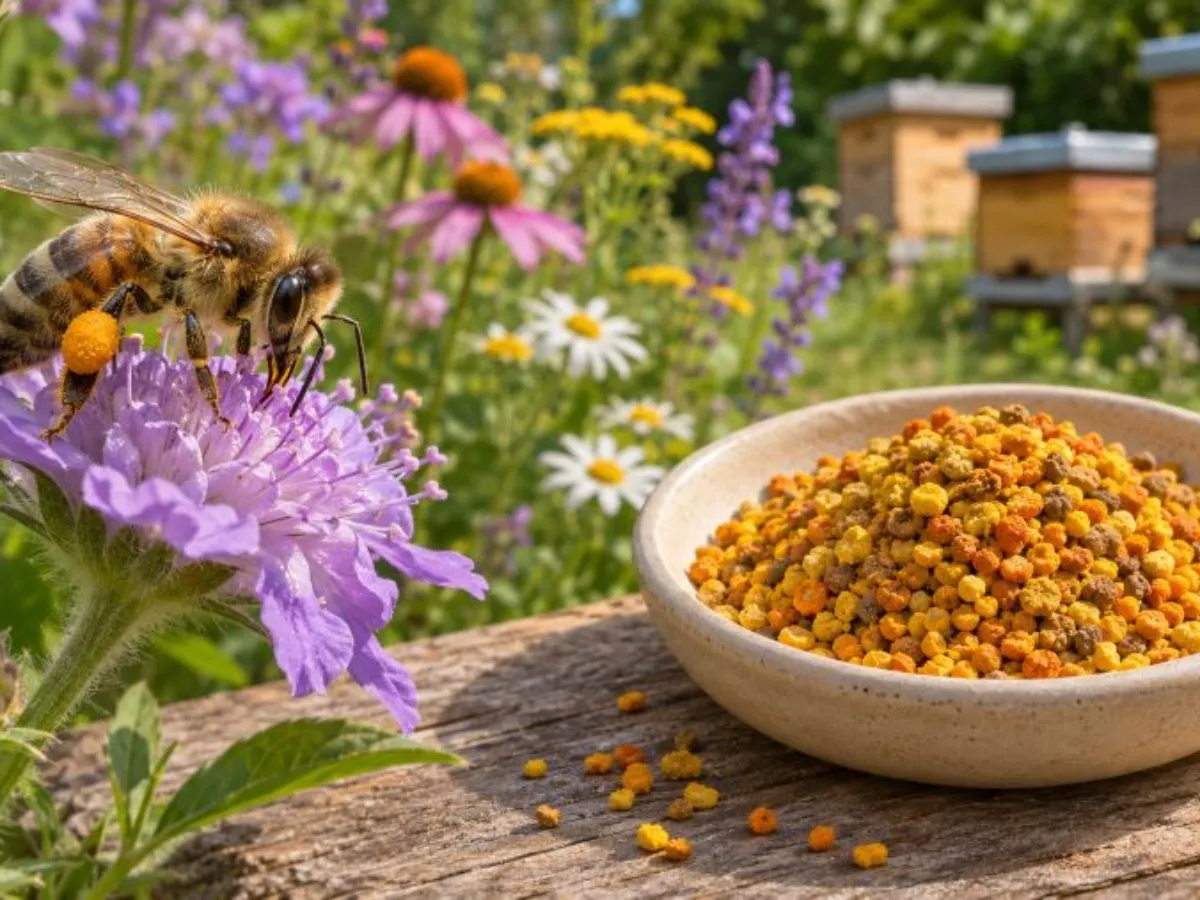
If you thought honey was the most nutritious thing bees make, you probably haven't met bee pollen. Bees fly from flower to flower, collecting pollen (the yellow-orange powder in the center of the flower), and mix it with a little nectar and their own special enzymes to create small, golden pellets. These pellets are essentially nature's "multivitamin"—they contain almost every nutrient the human body needs: proteins, amino acids, vitamins, minerals, and powerful antioxidants.
But beyond being a superfood, scientific research reveals that pollen has some highly surprising healing properties:
1. The Paradox: Using Pollen to Cure Spring Allergies! It sounds like a mistake: how can you take flower pollen, the number one cause of spring allergies (hay fever), to treat an allergy? What does the science say? It turns out that oral and highly gradual use of pollen acts like a "natural vaccine." When you introduce tiny amounts of pollen into the body and gradually increase the dose, the immune system "gets used" to it and learns not to react with panic. Additionally, pollen contains special antioxidants (like quercetin) that simply "lock" the cells in the body that release histamine—the substance that gives us a runny nose and watery eyes. Thus, proper and gradual treatment can actually help pull the body out of a seasonal allergy state.
2. Man's Best Friend: Prostate Health One of the most common problems for older men is an enlarged prostate (BPH) or chronic pelvic inflammation, which causes pain and difficulty urinating. What does the science say? Pollen is one of the most researched natural treatments in the world for this issue (in some countries, prescription prostate medications are based entirely on pollen extract!). It contains plant compounds that reduce swelling, relax the muscles in the area, and dramatically relieve pain and improve urine flow.
3. "Cleaning Services" for Your Liver Our liver is the body's filter—it works hard to clear out toxins, medications, and alcohol. Sometimes, it needs a little help, too. What does the science say? Studies show that pollen acts as a sort of "protective shield" for liver cells. It helps the liver cleanse itself of toxins, reduces damage caused by medications, and encourages the body to produce natural antioxidants that repair damaged tissue.
4. Protecting the Heart and Blood Vessels What does the science say? Pollen is very rich in a substance called "rutin," which strengthens the walls of blood vessels. Furthermore, consuming pollen has been proven effective in lowering "bad" cholesterol (LDL) levels in the blood and preventing its buildup in the arteries, contributing to a healthy heart and proper blood flow.
How to Use It (And What You MUST Watch Out For!) Because pollen contains actual flower pollen, the most important rule is gradual introduction. If you have never tried bee pollen, never take a full spoonful the first time. Start with just one or two granules and wait to ensure there is no allergic reaction (such as an itchy throat, shortness of breath, or a rash). If everything is fine, gradually increase the amount day by day.People who are known to be allergic to bee stings or have severe spring allergies must consult a doctor before use and take extra precautions, as sudden exposure to a large amount can trigger a severe allergic reaction.
Pollen is great mixed into yogurt, smoothies, or oatmeal (it is best not to heat it so you don't destroy its vitamins).
Key Clinical Sources and Studies for Further Reading:
1. Mechanisms of action of pollen in allergy, cardiology, and nutrition: A comprehensive review explaining how pollen helps stabilize the immune system, reduce allergic reactions (desensitization), and lower cholesterol. Komośińska-Vassev, K., et al. "Bee pollen: chemical composition and therapeutic application." Evidence-Based Complementary and Alternative Medicine (2015).Read more about this review (PMC)
2. The efficacy of pollen in treating the prostate: A controlled clinical study proving that pollen extract significantly improves urine flow and reduces chronic pelvic pain in men. Wagenlehner, F. M., et al. "A pollen extract (Cernilton) in patients with inflammatory chronic pelvic pain syndrome..." European Urology (2009).Read more about this study (PubMed)
3. Protection and restoration of the liver: A study demonstrating the ability of pollen to repair liver cells damaged by toxins and encourage the production of natural antioxidants. Yildiz, O., et al. "Hepatoprotective and antioxidant activity of bee pollen..." Journal of Food Science and Technology (2013).Read more about this study (PubMed)
© 2026 האיגוד הישראלי לאפיתרפיה וכותבי המאמרים. כל הזכויות שמורות. מותר לצטט קטעים קצרים בציון המקור וקישור למאמר.